Pay Attention or Invest It: A Small Reframe That Changes Your Week

Where Attention Goes, Energy Flows... and Four Words Most People Miss
During the pandemic, I spent a lot of time in peer support work with healthcare workers. People came in with the whole storm... staffing, the news, a family argument, a patient they couldn't stop thinking about. I'd help where I could and pass people to other resources when needed.
One small technique kept coming back. Not from me. From them.
They'd return weeks later and tell me "That thing... I used it with my kids. I used it before a hard conversation. I used it in the parking lot before going in for a shift."
The thing was an exercise called "5-4-3-2-1."
You may have heard of it.
It looks like this:
- Five things you can see.
- Four things you can hear.
- Three things you can feel.
- Two things you can smell.
- One thing you can taste.
You pick each one and let your attention rest on it for a beat. The color of the grass outside. The hum of an air conditioner. The watch on your wrist. The trinket on the des...
How to Network Without Working the Room (Or: Why the Best Networkers Don't Network)

If you've ever stood at a reception with white knuckles around your wine glass, contemplating your exit, this one is for you.
Networking advice tends to start in the wrong place. It assumes the goal is to meet useful people. It teaches you how to deliver an elevator pitch, how to position yourself near decision-makers, how to provide value strategically.
There's a problem with that whole frame.
It builds a quiet ledger underneath every conversation you have. You're giving so you can get. You're working the room.
And here's the thing: people feel it.
You've been on the receiving end of somebody "working the room." Their eyes scan past your shoulder mid-sentence. They're nodding, but they're looking for somebody better. You feel it before you can name it... and you usually don't forget it.
The fix isn't a better script. The fix is a different intent.
Warm the Room, Don't Work It
The shift sounds small. It isn't.
When I walk into a reception, my eyes go where yours go — to the p...
Plan Is a Verb and Why Planning Beats Plans

In 1987, Mike Tyson said, "Everyone has a plan until they get punched in the mouth."
A century earlier, a Prussian field marshal named Helmuth von Moltke said it more elegantly: "No battle plan survives first contact with the enemy."
Both quotes seem to contradict an old chestnut we've heard a hundred times: failing to plan is planning to fail.
They don't.
The Verb Hidden in the Old Line
That old line never said "failing to have plans."
It said "failing to plan."
Plan. The verb. The act of preparing.
A plan is static. It sits on a shelf. It lives in a quarterly report card with red, yellow, and green status circles. You can hand it to someone else and they can read it.
Planning is dynamic. It lives in your physiology... your breathing, your shoulders, and actually who walks through that door.
The First Responder Frame
A firefighter walks into a scene they have never seen before. The smoke is different. The layout is different. The people screaming are different.
Nothing abo...
(Sometimes) Hard Conversations Are Better As Campaigns Rather Than Events

There's a familiar line: when the student is ready, the teacher appears.
It usually shows up on a wall calendar with a sunset in the background. Most people read it as comfort — don't worry, when you're ready, the right teacher will show up.
But I think there's a corollary:
The best teachers lay the groundwork to make the student ready.
They aren't waiting on cosmic timing. They are doing patient, quiet (mostly invisible) work consistently and elegantly. When the student finally is ready, the teacher needs not only to be present but also recognizable.
Plant a seed.
Water the ground.
Come back next week and do it again.
This is one of the most underused skills in modern influence... and it has nothing to do with charisma, scripts, or the latest behavior-change technique. It's a frame shift. A different way of seeing your conversations entirely.
The wrong frame
Most of us walk into hard conversations expecting to solve them.
We sit down with an estranged sibling and want to re...
It Starts Before It Begins: The 4 Layers of Influence That Decide Every Moment

Most people prepare for the moment.
The moment was decided long before they got there.
I've spent 23 years studying influence across more disciplines than I can list cleanly - marketing, persuasive writing, hypnotherapy, stage performances, behavior change, body language, trial science, leadership, design and more. Each field has its own vocabulary, its own framing, its own "gurus."
But there's a single architecture every one of them eventually points to, and almost nobody names it cleanly.
It starts before it begins.
The 4 Layers of Influence
When you have an important moment ahead of you (a keynote, a meeting, a hard conversation, a sales call, a difficult family dinner), there's a temporal stack of choices that have already been made (well or poorly) long before you arrive.
Closer to the moment: more tactical.
Further from the moment: more foundational.
Here's the stack, walking backward from the moment itself.
Layer 1 - State management
This is the closest variable to th...
Toggling Empathy: How Empath-Leaders Stay Useful Without Burning Out

Most empath-leaders aren't suffering from a lack of empathy. They're suffering from too much of it, deployed without a dial (an empathostat?).
If you've ever come home from work still awashed in a feeling that didn't belong to you (a patient's grief, a colleague's fear, a team's anxiety), you already know what I'm talking about. The feeling isn't yours. (I mean... it is, but it isn't) You imported it. And the import was costly enough that, by the time you sat down on the couch, you didn't have much left for the people who actually live in your house.
This isn't a soft problem. It's an operational one. And, as such, it has an operational fix.
Empathy as a dial, not a switch
For years, I thought my options were two: (1) feel everything, or (2) close down. Caring all the way, or going cold. Both failure modes, imo. There's a third option, though.
That third option is standby.
Empathy isn't a binary. It's not on or off. It's more like a dial.
And off is its own kind of failure. Whe...
5 Shifts You Can Make in Under 5 Minutes (You Can Thank Me Later)

When I walk on stage and the room is flat (especially after lunch or after a dense technical session) I run a quick exercise before I begin.
It takes thirty seconds. Afterwards, people approach me about it almost as much as they approach me about something in the keynote itself.
Here's the exercise.
I ask the audience to first notice how they feel right now. Their mood. Their energy. Just take note of where they are.
Then:
Shoulders back. Deep breath in. Let it out. Smile - not like you have gas, a real one. Now turn to the person next to you and say, out loud: "I'm glad you're here."
Within seconds, the room is laughing, talking, alive. I then ask, "How do you feel now?"
They feel it. Energy, mood, engagement... all of it has moved in under a minute. Not because of me. Because of what they just did to themselves.
This is one example of what state management can look like in practice. It's small. It's repeatable. It's accessible wherever you are.
There are at least five things...
Responding vs. Responsive: The Hidden Skill That Builds Trust

Most of the people I coach who feel like they're falling behind at work are not falling behind. They're being responsive to the wrong thing.
They are deeply, admirably, exhaustingly responsive to their inbox. They are intermittently responsive to their calendar. They are barely responsive to the actual people on the other end of all of it.
This is one of the more painful diagnoses to deliver, because the person doing it feels like they're working harder than anyone else they know. And they are. They're just working in the wrong dimension.
Here is the distinction that, in my experience, untangles most of it.
Responding and being responsive are not the same thing.
Responding is the act of getting an answer back to someone. Responsive is the quality of having actually received what they sent.
A colleague sends you a question. You fire back a one-word answer in ninety seconds. You responded. Whether or not you were responsive is a separate question... and the honest answer is usually...
Credit Is Infinitely Divisible: Why the Best Leaders Give It Away

Have you ever worked for someone who always took the credit?
You remember how it felt.
You probably remember how long you stayed.
Now think about the opposite — a boss, a colleague, a teacher, a coach who acknowledged you specifically, in front of people who mattered, when you weren't even in the room. That memory is sharper, isn't it? More durable. You can probably name the person. You can probably name the project.
Credit is one of the most underrated forces in leadership, and almost no one teaches it well.
So let's teach it well.
The principle: credit is infinitely divisible
Most leaders treat credit like money. There's a fixed amount of it. If I give you some, mine decreases. If I lift you up in front of the room, my standing diminishes.
That model is wrong.
Credit is non-rivalrous. You can give it to ten people who genuinely contributed and your share doesn't shrink by a single ounce — assuming, and this is the load-bearing assumption, that the credit you give is sincere....
Can Cologne or Perfume Help You In Your Video Meetings?

In 1987, Van den Berghe and Mace ran a study most people have never heard of. Two hundred women rated two hundred men on attractiveness... on video. The video recordings were made in advance. There was no scent transfer possible. No shared room. No live contact.
Half the men were wearing cologne when the recording was made.
Half were not.
The ones wearing cologne were rated more attractive.
The cologne never reached the women. So what happened?
The cologne worked on the men.
Their bodies registered the scent. Posture shifted. Voice settled. Face softened. The camera picked up the difference and carried it through to the screen the rater was watching, days or weeks later.
Your state shows up on camera before you do.
That is the lesson, and it is bigger than cologne.
Why state matters more than appearance on camera
We tend to think of "looking good on video" as a problem of lighting, framing, wardrobe, and posture. Those things matter, but they are downstream variables. The ups...
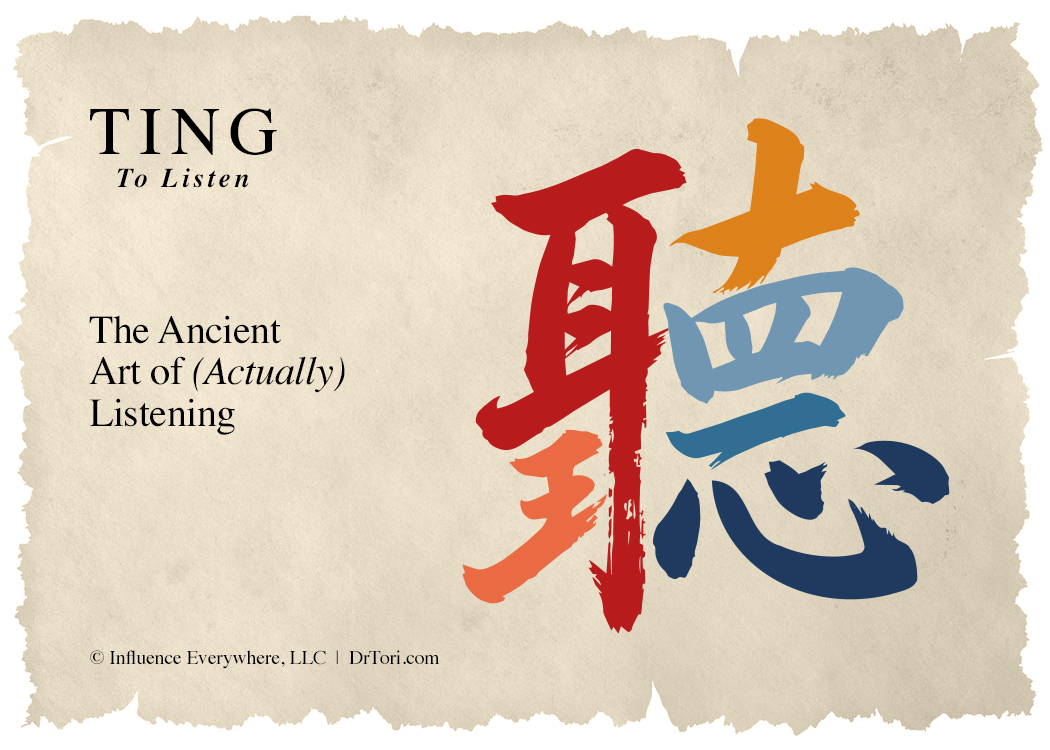
What's Your Listening Score?
How well do you listen?... like actually listen? This one word will change every interaction you have from now on. See where you stand...

Get Your Conversation Score
How well do you navigate conversations? Struggle with small talk? Fumble the greeting? Find out...

What Are Hypnotic Gifts?
You can transform someone's life in a single conversation. In his new book, Dr. Tori gives you the map.
